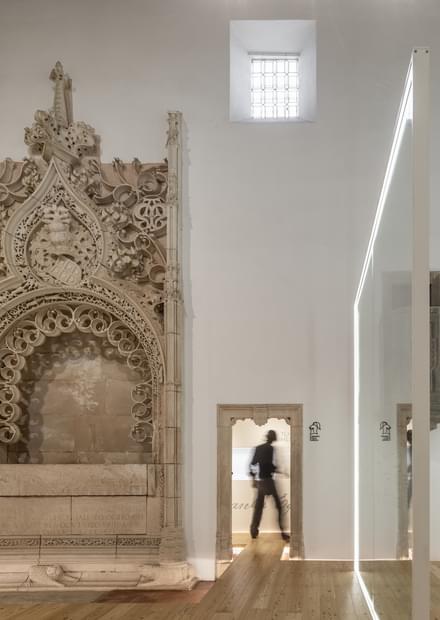
Beautifully located next to the castle of Abrantes, the building was carefully renovated and enlarged in a flawless work aligned with the UNESCO heritage charters. The renovation project took into account the key features that give this building its value within its socio-cultural context, with a view to carrying out restoration, refurbishment and technological modernisation work.
The building - Edifício Carneiro - features an architectural style inspired by the chalets of the period, evident in the three sections – two at the top and a central one – which are slightly set back from the elongated, parallelepiped-shaped section below, with pronounced gabled roofs and openings of simple geometry, as well as in the terraced courtyard/garden flanked by walls.
Given the existing floor area and the architectural and structural characteristics of the Carneiro Building, it was decided to create support spaces for the museum in an adjoining building.


João Charters de Almeida
Born in 1935, João Charters de Almeida is one of the leading figures in contemporary Portuguese sculpture, with works on an architectural scale scattered across several continents. From clay to bronze, from stone to concrete, his works can be found in Portugal, the United States, Canada, Italy, China and Brazil, amongst other countries.
His trademark is known as "Imaginary Cities", huge vertical structures made in concrete, marble or steel that seem to defy gravity and the surrounding space. In his work, the heavy matter contrasts with the void. The gaps in his works are not flaws, but elements that were designed to let the light, the sky and the movement in. These structures can reach up to 40 meters high and can be contemplated in parks and countries all over the world.
His artistic work also embraces ceramics, painting, printmaking, drawing, design and set design, as well as costume design for opera and ballet.
Charters de Almeida collection
The narrative of this collection, which reflects this intense creative activity, is part of the permanent exhibition spread across 17 exhibition rooms, situated mainly on the first and second floors of the museum.
The visitor route starts at the house and continues through a courtyard, creating an open-air exhibition trail leading to the entrance to the Castle Gardens, whilst also offering a superb view of Aquapolis on the banks of the River Tagus, notably of the sculpture ‘Cidade Imaginária’ (Imaginary City), which he created.