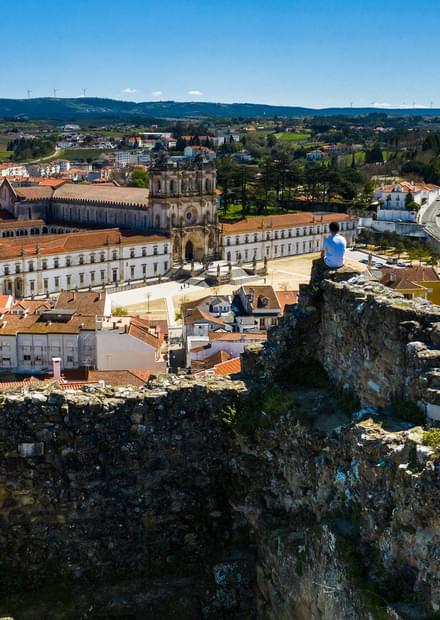
Of the more than 400 monasteries affiliated to the Abbey of Clairvaux, this was the last Benedictine monastery to be founded whilst St Bernard was still alive, thanks to a very generous donation by King Afonso Henriques in 1153: a territory covering 440 square kilometres!
St Bernard of Clairvaux said that God is width, length, height and depth. The Royal Monastery of Santa Maria de Alcobaça seems to bear this out: its church, unique in the world and in the architecture of 12th- and 13th-century Europe, has three naves of the same height! Sumptuous 22 metres!
And there is yet another remarkable fact: Alcobaça Abbey is an exact replica of the original 12th-century French Abbey of Clairvaux, which was destroyed during the French Revolution (1812).
Alcobaça Monastery is a stone embodiment of Cistercian minimalism: colourless stained-glass windows through which pure light streams, plant motifs, scale, and aesthetic austerity!
Work on the church began in 1178 and was completed a century later. In the church, the master stonemasons of the Cistercian Order experimented with what was, at the time, a new ‘style’ of construction – the Gothic – thereby introducing this new architectural language to Portugal.
In the church’s ambulatory, the ceramic flooring is still the original: medieval terracotta and glazed clay tiles.
Two of the Italian sculptures on the church’s early 18th-century Baroque façade are carved from Carrara marble.
The pinnacles and corbels of the towers resemble intricate stone lacework. Everything in Alcobaça is masterful!
As the royal pantheon of the Portuguese monarchy, the Monastery of Alcobaça houses the tombs of King Pedro I and Inês de Castro, dating from the 14th century and considered masterpieces of European funerary sculpture.
Featuring a rich decorative programme, the highlights include the depictions of the Last Judgement on the tomb of D. Inês and the Wheel of Life on the tomb of D. Pedro.
There are also 169 monumental terracotta sculptures, produced by the Cistercian monks: polychrome and gilded, dating from the 17th and 18th centuries – between 1670 and 1765 – they constitute a remarkable collection of sacred art.
The 169 sculptures are divided into five sculptural groups: the Royal Series, the High Altar Ensemble, the Altarpiece of the Consecration of Saint Peter, the Reliquary Chapel and the Altarpiece of the Death of Saint Bernard.
The Monastery of Alcobaça remains a unique Cistercian complex: in addition to the church, it preserves the cloister, the sacristy, the chapter house, the monks’ hall – where the famous scriptorium is thought to have been located – the dormitory and the refectory.
There are also buildings from the Modern Period (16th to 18th centuries): the Abbot’s Palace and the Guest House, the Hall of Conclusions, the Kitchen, the Hall of Kings, the Cardinal’s and Rachadouro Cloisters, the façade, the New Sacristy and the Reliquary and Exile Chapels, all masterpieces of the Baroque in Portugal.
And there is also the group of eleven centuries-old cedars (Cedrus atlantica) that still stand within the old inner monastic enclosure.


An imposing kitchen
The 18th-century kitchen is the third kitchen the monastery has ever had.
Built between 1720 and 1752, it is characterised by its imposing 26-metre chimney, supported by cast-iron columns – a feature entirely unexpected in 18th-century architecture.
It is clad in tiles dating from 1752: thousands of tiles with infinite shades of white and a simple blue decoration!
Seven washing troughs dominate the kitchen: running along the elevation is the drinking water pipe from the Chiqueda spring, which runs the entire length of the kitchen to feed a fountain outside!
And there is the trough that received water from the levada, which came directly from the River Alcoa for washing!
aquae ductus
It is an inscription on a tombstone that marks the exact spot where the drinking water pipeline runs! The monastery is situated at the confluence of the Alcoa and Baça rivers, and the Chiqueda spring is very close by.
This is proof that the Cistercian monks’ expertise in hydraulic and agricultural engineering was unrivalled: within the monastery grounds, the monks cultivated the fields, tended the flocks, extracted iron and established the country’s first industries.
They cleared the moors and drained the marshes.
They planted a variety of crops, including both vegetables and fruit. This knowledge was passed on by the farm masters to the neighbouring communities, through constant contact and the exchange of knowledge amongst everyone.
The great expansion of the mid-14th century marked a period of prosperity and tranquillity. It was during this time that the Abbey’s library became one of Portugal’s greatest cultural centres.
For centuries, the Ecclesiastical Lordship managed, with ingenuity and skill, corvée labour and land rents; it oversaw the circulation of goods; received kings and queens; observed 245 days of abstinence and 152 days of fasting; and looked after professed monks, lay brothers and novices.
All because, for the Cistercian Order, establishing a monastery required seclusion, woodland, stone and water!
The highly diplomatic, timely and astute donation by D. Afonso Henriques had all of these.
And in abundance!
Location
Google Maps
Opening hours
From October to March
09:00 - 18:00 (last entrance at 17:30)
From April to September
09:00 - 19:00 (last entrance at 18:30)
The ticket office closes 30 minutes before closing time.
Closed on January 1st, Easter Sunday, May 1st, August 20th and December 25th