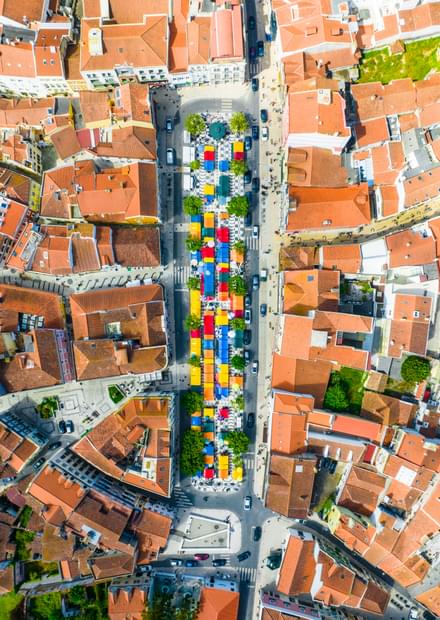
Covering 11 hectares, D. Carlos I Park is a luxurious green space in the town of Caldas da Rainha, with a rich history to match.
Around 1747 – during the reign of King João V of Portugal – the concept of an exclusive leisure area was introduced, and it was at this time that an area clearly intended for patients to take walks was established.
As part of the extensive reforms he undertook at the Hospital, King João V ordered the construction of the Casa da Convalescença ("Healing House"), thereby justifying the need to acquire land for this new purpose.
In the 18th century, a renewed interest in thermal stations emerged in Caldas da Rainha: numerous analyses of the thermal waters were carried out, and their composition and therapeutic uses were discussed.
It was also at this time that a certain social shift began to be felt, which would come to fruition in the 19th century with the emergence of the bourgeoisie, leading to changes in customs and traditions and the emergence of new social habits.
It is against this backdrop that the adoption of the promenade, leisure and entertainment as a new complementary element of therapeutic treatment took root, leading to the emergence of the Passeio da Copa, commissioned by the Administrator of the Caldas da Rainha Thermal Hospital, Dr António Gomes da Silva Pinheiro, in the second half of the 18th century.
The former Passeio da Copa
The Passeio da Copa was a typical Baroque garden, featuring an axial layout, retaining walls and staircases, which provided patients with a recreational space for outdoor walks whilst they were undergoing treatment at the Thermal Hospital.
This initial design was altered in 1806 with the layout of the new Passeio das Caldas, which marked the beginning of the current park and corresponds, today, to its northern section.
The 19th century brought unprecedented socio-economic enthusiasm to Caldas da Rainha. Visits by the royal family became a regular occurrence, triggering a flurry of high-society activity, placing the town on the map of the nation’s most sought-after and renowned tourist destinations, and earning it the status of a fashionable spa resort.
The leisure aspect of the resort came to the fore, with the emergence of the Club, where visitors could play games, dance and listen to music; country dinners and picnics were also organised.
More than just a form of therapy, the thermal baths became a leisure activity in their own right, leading to the development of new supporting infrastructure.
The construction of the Western Railway Line in 1887, a distinctive symbol of modernity, would reinforce and expand this context.
Successive management teams at the Caldas da Rainha Thermal Hospital sought to meet the demands of new audiences, in line with new medical, social and care requirements.
The touch of a genius called Berquó
In 1888, with the arrival of the administrator Rodrigo Maria Berquó, a new chapter in the history of the Thermal Hospital began.
Rodrigo Maria Berquó began by requesting funds from the 1888–89 budget to transform the existing vineyards near Passeio da Copa into a wooded park featuring a large lake. His vision did not stop there; he also saw the need to introduce various forms of entertainment – games, tennis, cricket, ball games, pistol shooting, music in the bandstand and boat trips on the lake.
Berquó expanded the park, commissioned the construction of the artificial lake, and oversaw the fencing and policing.
To expand the landscaped area, it was necessary to use the hospital’s farmland, but there was also a need for some land expropriations, which inevitably caused controversy.
The construction of the Artificial Lake, an innovative feature which was due to open in 1891, would raise the issue of its water supply. The initial plan was to feed it with thermal water, thereby making use of the surplus water from therapeutic treatments.
However, this measure would not be sufficient, leading to the approval of a further supplementary budget to purchase cast-iron pipes to carry water from the forest reservoir to the spa and D. Carlos I Park.
And so it is that the new Park becomes a celebration of sentimentality and naturalism, in keeping with the landscape style in vogue throughout Europe.


The 20th century
In the first two decades of the 20th century, following the establishment of the republic, the park was all but forgotten by successive hospital administrations.
From the 1930s onwards, attention began to be paid once more to the park, which had been neglected; it was now a favourite spot not only for visitors but also for the people of Caldas da Rainha.
In the second half of the 1940s, improvements and embellishments to the park were the order of the day.
Although the lack of funds remained a major problem, the Association for the Defence of Caldas’ Interests, in collaboration with the management of the Caldas da Rainha Thermal Hospital, highlighted the importance of including the Park in an urban development plan to be implemented by the landscape architect Caldeira Cabral.
The project began in 1948 and the works continued until 1951. With this project, more regular shapes were restored, wasteland was turfed, hedges of varied and colourful flowers were cultivated, and trees were planted, creating interplays of light and shade. Fountains and ponds, tiles and stone spouts punctuated the space.
The hospital now had its own flower greenhouse, where it could preserve existing plants and develop new species.
The project also included the extension of the José Malhoa Museum and the construction of a restaurant-bar to replace the terrace, as well as the refurbishment of the skating rink.
In the botanical survey carried out in 2010, 157 species of trees and shrubs were recorded in D. Carlos I Park, along with a nursery of Portuguese oaks and other species of the original Mediterranean flora, algae, ferns, mosses, small non-vascular plants and lichens.