Legend has it that around 1484, during a journey from Óbidos to Batalha, Queen Leonor (wife of King João II) passed by a spot where several people were bathing in strong-scented waters. She quickly realised that these were waters with healing powers, but the monarch wanted to verify the reports for herself.
According to the legend, her ailments were cured and therefore, in the following year, she ordered the construction of a thermal hospital on that site. The building was built in 1485 and it can be still visited nowadays. This is why the city was named Caldas da Rainha, meaning the Queen's thermal stations.
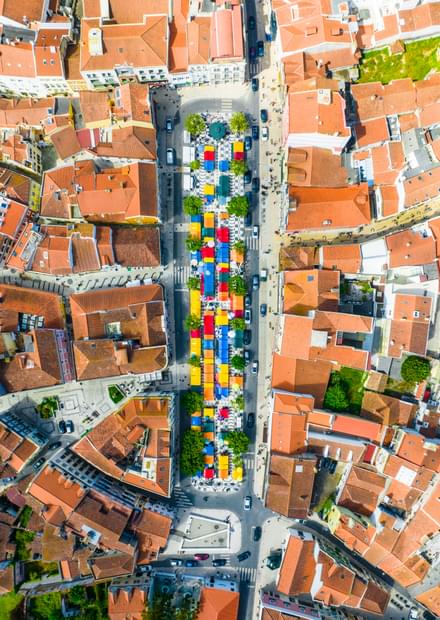
The village of Calda da Rainha was founded and developed, at the behest of Queen Leonor, around the thermal complex.
The construction of the hospital and the church required a substantial investment from the Queen: she sold her jewellery in order to purchase furniture, utensils, clothing and other items.
To ensure the institution’s long-term viability, she donated to the hospital and its providers all the taxes, tithes, rents, rights and feudal dues from the towns of Óbidos, Aldeia Galega and Merceana.
The Church support was also crucial: she sought backing at the highest levels, authorisations for the construction of the church and appeals to Papal Bulls. The works are believed to have taken place in several phases, due both to the scale of the project and a lack of funds.
By 1490, the church and the hospital were already fully operational, the latter comprising two storeys. On the ground floor of the church were the wards for bedridden patients – who could thus attend Mass at the Church of Nossa Senhora do Pópulo, which was directly connected to the hospital. This was also the floor where the baths were located.
On the upper floor were the remaining wards, with a total of 110 beds, 70 of which were reserved for the poor. The period for treatment ran from 1 April to the last day of September, and every year on the first day the ‘Compromisso’ – dated 1512 – was read out; this document set out a series of rules established by Queen Leonor to ensure the smooth running of ‘her’ hospital.
The thermal building, erected during the transition from the Baroque to the Neoclassical period, still reveals a Mannerism style in the treatment of the corners. The cornice forms a projection that lends a distinctive dynamic to the façade, the central section of which adheres to classical principles.
The main façade faces a large square, formerly known as Largo da Copa, which leads to Parque das Termas, flanked by the Clube de Recreio and the Balneário Novo (or Casa da Convalescença), a neoclassical building with a rectangular floor plan
Crossing the passageway leading to the Church of Nossa Senhora do Pópulo is a fountain of great visual impact by the sculptor José Aurélio.
Remnants of 16th- and 18th-century tiled panels are still visible, notable for their great creativity in terms of compositional balance and aesthetic quality.
The spa complex comprises six wards for men: São Francisco, São Camilo, São João de Deus, São Pedro, Santo Amaro and Nossa Senhora do Pópulo; and two for women: Santa Isabel and Santa Clara.
In the current building there is a swimming pool which suggests the existence of an earlier structure dating back to the hospital’s earliest days.
The thermal waters of Caldas da Rainha are rich in minerals and renowned for their therapeutic benefits in treating respiratory, rheumatic and musculoskeletal conditions.